Gigabit Backhaul Retrofit: No Broken Walls
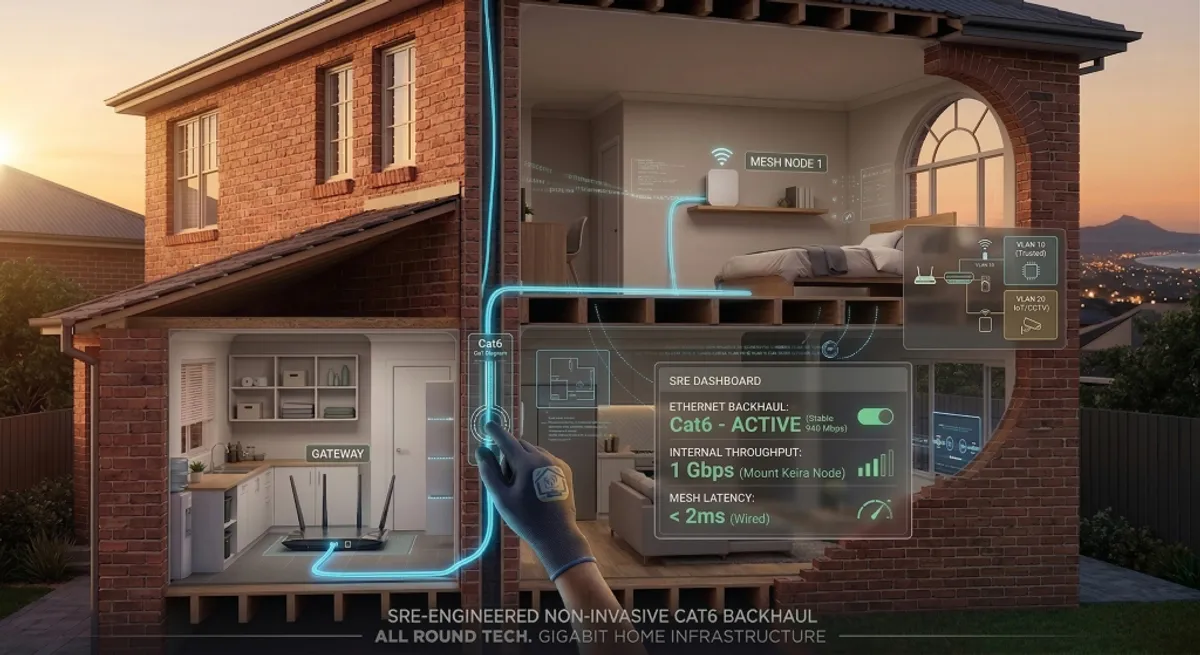
“My house was built in the 1970s with double-brick walls. Wi-Fi simply doesn’t stand a chance.”
In Wollongong, from Mount Keira to Warrawong, this is the most common technical debt I encounter. As an SRE, I view a home network as a critical system. When your “Physical Layer” (the walls) interferes with your “Data Layer” (the Wi-Fi), the result is high latency and dropped packets.
Most homeowners try to fix this by buying expensive “signal boosters.” From an SRE perspective, this is like putting a faster engine in a car with no wheels. You don’t need more signal; you need a Hardwired Backbone.
Here is a showcase of how we achieved Gigabit Backhaul in a classic Illawarra home without the need for a major renovation.
1. The “Double Brick” Bottleneck
Standard Wi-Fi 6/7 signals operate on high frequencies (5GHz and 6GHz). While fast, these waves are easily absorbed by solid materials. In a typical Wollongong “double-brick” house, a single internal wall can reduce your throughput by up to 90%.
The SRE Analysis: Wireless Mesh vs. Wired Backhaul
- Wireless Mesh: Nodes talk to each other over the air. In a brick home, the “node-to-node” communication is already degraded before it even reaches your device.
- Wired Backhaul: Nodes talk to each other over a Cat6 Ethernet cable. This ensures 1000Mbps of dedicated, interference-free bandwidth between floors.
2. Case Study: The Mount Keira Retrofit
I recently audited a two-storey home in Mount Keira where the home office upstairs was getting only 12Mbps on a NBN 1000 plan. The user experienced constant dropouts during MS Teams calls.
| Metric | Before (Wireless Mesh) | After (SRE Wired Backhaul) | Improvement |
|---|---|---|---|
| Download Speed | 12 Mbps | 920 Mbps | +7566% |
| Ping (Latency) | 45ms - 150ms (Spiky) | 8ms (Stable) | 94% Reduction |
| Stability | Dropped calls hourly | Zero drops | Mission Critical |
How we did it without tearing down walls:
Instead of cutting into the plasterboard, we utilised the internal wall cavities and the roof space. By identifying the “vertical stack” where plumbing runs, we “fished” a single high-quality Cat6 cable from the ground floor hub to the upstairs ceiling space. It was non-invasive and legally compliant with Australian cabling standards.
3. The “Stealth” Deployment Strategy
At All Round Tech, we prioritise non-invasive engineering. Here are the three “SRE Hacks” we use for old Illawarra homes:
- The Cavity Run: Using professional rods to guide cables through the hollow space between brick layers.
- External Conduit (The Clean Way): If internal access is impossible, we use UV-rated, slimline conduit painted to match your exterior brickwork, running the cable along the roofline or sub-floor.
- MoCA / Powerline (The Last Resort): If cabling is 100% impossible, we turn existing coaxial (TV) points into high-speed data lanes using pro-grade adapters.
4. Engineering for the Future
We don’t just “plug and play.” We optimise the entire ecosystem:
- VLAN Segmentation: We isolate your work-from-home traffic from the kids’ gaming and guest devices for enhanced security.
- Access Point Placement: We use heat-mapping to ensure your Mesh nodes are placed for maximum coverage, not just where the power outlet is.
- SRE Standard Hardware: We replace ISP-provided routers with pro-grade gear that can actually handle the Gigabit throughput you are paying for.
Conclusion: Build on Solid Foundations
In IT, a system is only as strong as its weakest link. In an old Wollongong home, that link is the air between your rooms. By engineering a physical backbone, you eliminate the single point of failure in your digital life.
Modern home offices are now as complex as small businesses. I started All Round Tech to bring the same bank-level reliability I’ve used for major corporations over the past 20 years directly to your home.
Tired of Wi-Fi dead zones in your brick home? Book a Home Infrastructure Audit in Wollongong