Smart Lighting: Using 'Vacation Mode' to Deter Intruders
“A house that stays dark for three nights in a row is a house that’s empty.”
In the Illawarra, especially during the school holidays, empty homes become targets. Most people try to solve this with simple timers that turn a lamp on at 6 PM and off at 10 PM. The problem? Professional burglars look for patterns. If your lights turn on at the exact same minute every day, they know it’s an automation.
As an SRE, I solve this using Entropy and Randomisation. At All Round Tech, we don’t just “set timers”; we engineer a Simulated Presence that makes your home look lived-in.
1. Beyond the Timer: The Psychology of Presence
A real human doesn’t behave like a clock. We move between rooms, we stay up later on Fridays, and we don’t always turn the hallway light on at exactly 18:00:00.
To a criminal scouting a street in Wollongong, the difference between a “Timer” and a “Person” is in the Jitter: the slight, unpredictable variations in timing and location.
2. Engineering “Vacation Mode” (The SRE Approach)
When we configure a smart home system (like Home Assistant or Philips Hue), we apply the All Round Tech Standard for occupancy simulation:
A. Stochastic Randomisation (The Jitter)
Instead of a fixed schedule, we program a Variable Window.
- Rule: “Turn on Living Room Light at Sunset +
random(-20min, +20min).” - Result: Every night is different. To an outsider, it looks like someone is actually reaching for a switch.
B. Room Sequencing (The Pathing)
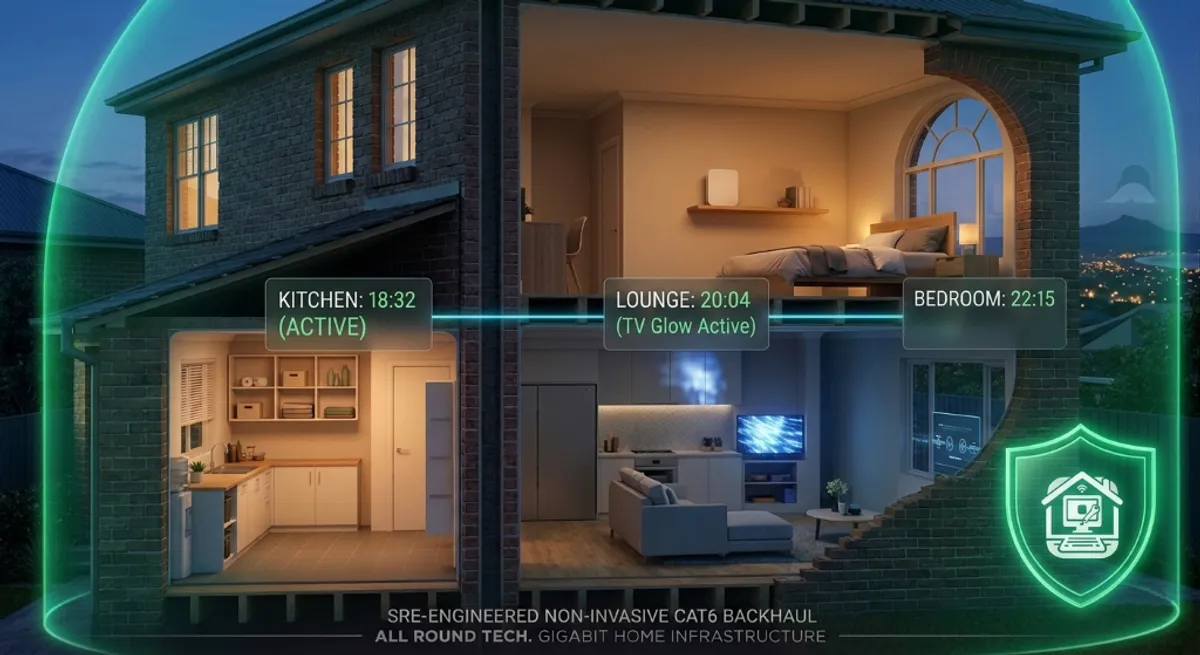
Humans move in patterns. We turn on the kitchen light, then the dining room, then the lounge. Our automations follow this logical flow:
- Sunset: Outdoor security lights dim up.
- 18:30: Kitchen lights activate (Cooking simulation).
- 20:00: Living room lamp turns on; Kitchen turns off.
- 22:30: Master Bedroom light flickers on for 10 minutes before total blackout.
C. TV Simulation
Using an addressable LED strip or a smart plug on a TV, we can mimic the shifting blue-light glow of a television reflecting off the curtains. This is a massive deterrent that screams “Someone is watching a movie.”
3. Data-Driven Security: Does it Work?
According to Australian crime statistics, burglars are 75% less likely to attempt a break-in if they perceive the home is occupied.
| Method | Visibility | Pattern Recognition | Security Rating |
|---|---|---|---|
| Dark House | Zero | High (Easy Target) | CRITICAL |
| Basic Timer | Low | Medium (Predictable) | LOW |
| SRE Vacation Mode | High | Low (Unpredictable) | HIGH |
4. Integration with Your Security Stack
At All Round Tech, we integrate your lighting with your CCTV and VLAN-Isolated IoT network. If your cameras detect a person at the perimeter while you are away, the “Vacation Mode” can trigger an Active Response: every light in the house flashes at 100% brightness, instantly stripping the intruder of their cover.
Conclusion: Engineering Peace of Mind
Your home is your most valuable asset. Don’t let its “Off-Duty” state be its weakest link. By applying Site Reliability Engineering principles to your smart lighting, you create a digital scarecrow that protects your family’s sanctuary in the Illawarra.
Heading away soon? Book a Smart Home Security Review in Wollongong